






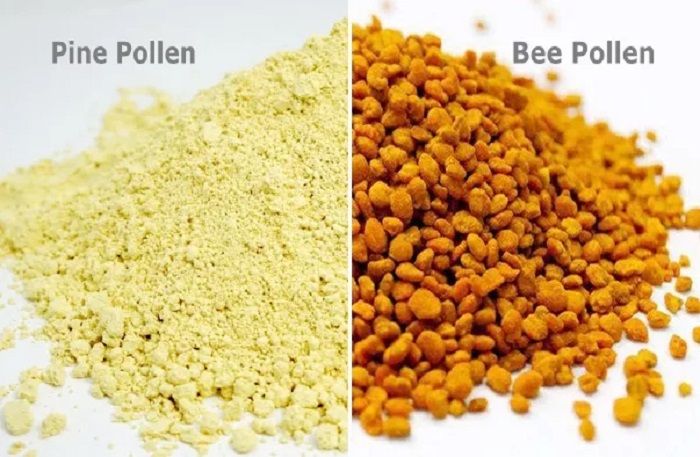
Pine Pollen vs Bee Pollen is a comparison many shoppers make too late. They often buy first and ask questions later. That is a mistake. These two products may sit in the same supplement category, but they come from very different sources, offer different nutrient patterns, and carry different considerations for taste, use, and safety.
Pine pollen comes from pine trees. Bee pollen comes from flowering plants, but bees collect it, pack it, and mix it with nectar and bee secretions. That alone changes the final product. It changes the composition. It changes the flavor. It also changes the allergy profile.
In practice, beginners tend to see both as “natural pollen supplements” and assume the rest is minor. It is not. The smarter way to compare them is simple: start with origin, then look at nutrients, processing, consistency, evidence, and risk. After that, the choice becomes much easier.
This guide explains the difference in plain English. You will see what pine pollen and bee pollen are, how they compare, what the science can and cannot support, and which one may fit better depending on your goals and tolerance.
What is the short answer to Pine Pollen vs Bee Pollen?
Pine pollen and bee pollen are not interchangeable. Pine pollen is pollen harvested from male pine cones. Bee pollen is flower pollen collected by honeybees and formed into granules with nectar and bee-derived substances.
As a result, bee pollen acts more like a mixed botanical-bee food. Pine pollen acts more like a plant-derived pollen supplement. They overlap in broad nutrient categories, yet they differ in source, taste, variability, and the way brands position them in the market.
Where do pine pollen and bee pollen come from?
Pine pollen is harvested from male cones of pine species. Manufacturers dry it and sell it as powder, capsules, tinctures, or so-called cracked-cell products. The idea behind cracked-cell processing is to improve access to nutrients inside the pollen wall, although the real impact depends on the product and method.
Bee pollen starts in flowers, but bees shape the final material. Worker bees collect pollen grains, combine them with nectar and salivary enzymes, and form pellets that are brought back to the hive. Beekeepers then collect part of that pollen load.
This difference matters because bee pollen usually reflects many floral sources. Its composition can shift with geography, season, weather, and local plants. Pine pollen also varies, but species and processing tend to drive that variation more than floral diversity.
| Feature | Pine Pollen | Bee Pollen |
|---|---|---|
| Main source | Male pollen from pine trees | Flower pollen collected by honeybees |
| How it is made | Harvested, dried, milled, or extracted | Collected by bees, mixed with nectar and bee secretions |
| Common forms | Powder, capsules, tincture | Granules, powder, capsules |
| Natural variation | Depends on pine species and processing | Depends on floral source, region, and season |
How do the nutrient profiles compare?
Both products contain nutrients and plant compounds. Still, their profiles are not identical. Bee pollen is often described as a broad-spectrum functional food because it can provide protein, carbohydrates, lipids, fiber, vitamins, minerals, and polyphenols. Pine pollen also contains protein, amino acids, carbohydrates, minerals, and plant bioactives such as flavonoids and polysaccharides.
However, there is an important caveat. Labels can make these products look more precise than they really are. Pollen is a variable raw material. The exact mix can change from batch to batch. Bee pollen tends to show stronger variability because its floral origin can be mixed. Pine pollen is usually more consistent by source category, but still not uniform across species and brands.
That is why shoppers should not focus only on broad terms such as “superfood,” “adaptogen,” or “nutrient-dense.” Those words sound useful, but they are vague. A better question is whether the product has transparent sourcing, a sensible serving format, and quality testing.
Review papers on bee pollen describe it as a complex material that may contain proteins, fats, carbohydrates, minerals, vitamins, phenolics, and other bioactive compounds. Review papers on pine pollen also describe a mix of amino acids, minerals, flavonoids, and polysaccharides, but human evidence remains much thinner than marketing often suggests.
Does one offer better evidence than the other?
Bee pollen has the broader research base overall, especially in food science and composition analysis. Pine pollen has a smaller evidence base and is discussed more often in traditional-use or preclinical contexts. That does not make pine pollen useless. It simply means the confidence level should stay moderate.
For both products, a common problem appears in marketing. Brands often move from lab findings to strong lifestyle claims. That leap is too large. Cell studies, chemical analysis, and animal studies can be interesting, but they do not automatically predict what a person will notice in daily use.
So the realistic view is this: bee pollen is better studied as a nutrient-rich bee product, while pine pollen gets more speculative attention in the supplement market. Neither product has the kind of strong human evidence that would justify dramatic promises.
Why is pine pollen often marketed differently?
Pine pollen is frequently positioned around vitality, performance, masculinity, balance, and hormonal curiosity. That style of marketing is common because it is memorable and emotionally strong. Yet the science behind those themes is not as settled as the product pages often imply.
Some brands also emphasize compounds naturally present in pine pollen and suggest that this sets it apart from bee pollen. The problem is not that pine pollen contains interesting compounds. The problem is that shoppers can confuse presence with proven effect. Those are different things.
The safer interpretation is straightforward. Pine pollen may interest people who want a plant-based pollen supplement and do not want a bee-derived product. Beyond that, expectations should stay grounded.
What does bee pollen do better for beginners?
Bee pollen is usually easier to understand at first glance. It is often sold as granules, which makes the product feel more food-like and less extract-like. It also fits naturally into smoothies, yogurt bowls, and functional food routines.
In addition, bee pollen has a more familiar market identity. Many users approach it as a nutrient-dense food rather than a highly targeted supplement. That makes expectations more realistic. People tend to ask, “Does this fit my diet?” instead of expecting a dramatic result from one ingredient.
Still, beginner-friendly does not mean risk-free. Bee pollen has one caution that deserves extra attention: allergy risk.
Which safety issues matter most?
The biggest practical risk in this comparison is allergy. Bee pollen can trigger allergic reactions in sensitive individuals, including serious reactions in documented case reports. This is especially relevant for people with pollen allergies, asthma, or sensitivity to bee-related products.
Pine pollen is not automatically risk-free either. Any pollen-based product can be poorly tolerated by some users. However, bee pollen has more direct documentation in the literature for allergic reactions. That makes caution especially important.
There is another issue. Supplements are not all processed the same way. Quality, contamination control, and labeling can vary between brands. For that reason, third-party testing and transparent sourcing matter more than dramatic branding.
| Decision factor | Pine Pollen | Bee Pollen |
|---|---|---|
| Best fit for plant-only preference | Yes | No, bee-derived |
| Food-like everyday use | Less common | More common |
| Documented allergy concern | Possible | Higher concern |
| Marketing hype level | Often high | Moderate to high |
| Human evidence strength | Limited | Limited, but broader literature |
How should you choose between pine pollen and bee pollen?
Start with your tolerance and product preference. Then move to quality control. That order works better than chasing claims.
Use this checklist before you buy
- Check whether you have pollen, bee product, or seasonal allergy issues.
- Choose a product with clear sourcing and simple labeling.
- Look for third-party testing or at least transparent quality standards.
- Decide whether you want a bee-derived product or a plant-only option.
- Prefer realistic language over exaggerated performance promises.
- Start with a conservative serving if you are trying a pollen product for the first time.
If you want a bee-derived functional food with a broader nutritional identity, bee pollen may feel more intuitive. If you want a plant-based pollen product and accept that the evidence is still limited, pine pollen may be the more relevant option.
What mistakes do shoppers make with pollen supplements?
The first mistake is treating all pollen as basically the same. It is not. Tree pollen and bee-collected flower pollen belong to different product stories.
The second mistake is trusting product language more than raw facts. Terms such as “energy,” “vitality,” “balance,” and “wellness support” can sound meaningful while saying very little.
The third mistake is ignoring variability. Natural products can vary a lot. A review, a label, and a social media clip may describe one version of a product, not every version on the market.
The fourth mistake is forgetting safety. With bee pollen especially, a “natural” label should never erase the possibility of an allergic response.
Which one is better for daily use?
There is no universal winner. Bee pollen may fit daily food routines more naturally because granules are easy to add to meals. Pine pollen may suit shoppers who want a plant-only supplement format, especially in capsules or powders.
The better question is not “Which is stronger?” The better question is “Which product type matches my tolerance, preferences, and expectations?” In most cases, that leads to a smarter decision than chasing the more heavily marketed option.
FAQ about Pine Pollen vs Bee Pollen
Is pine pollen the same as bee pollen?
No. Pine pollen comes from pine trees, while bee pollen is flower pollen collected and processed by bees.
Does bee pollen contain more nutrients than pine pollen?
Bee pollen often has a broader food-style nutrient profile, but exact composition varies by floral source and batch.
Which has a higher allergy risk?
Bee pollen is the bigger concern because allergic reactions are documented more clearly in the literature.
Is pine pollen vegan?
Yes, pine pollen is plant-derived. Bee pollen is not vegan because bees collect and process it.
Can beginners use either one?
Some do, but beginners should focus on tolerance, sourcing, and label quality before making either product a routine choice.
Which one has better human research?
Bee pollen has broader literature overall, but both still have limited strong human outcome data.
Glossary
Pollen: Fine reproductive particles produced by seed plants.
Bee pollen: Flower pollen collected by bees and mixed with nectar and bee secretions.
Pine pollen: Pollen harvested from male cones of pine species.
Polyphenols: Plant compounds studied for antioxidant activity.
Flavonoids: A class of polyphenols found in many plant materials.
Polysaccharides: Complex carbohydrates found in many natural products.
Bioactive compounds: Naturally occurring substances that may interact with biological systems.
Third-party testing: Independent testing used to check quality, purity, or contamination.
Structure/function claim: A claim about supporting normal body structure or function, not treating disease.
Anaphylaxis: A severe allergic reaction that requires urgent medical attention.
Conclusion
Pine pollen and bee pollen may look similar in a product lineup, but they are different in origin, composition, and practical use. The best choice depends less on hype and more on source, tolerance, quality, and realistic expectations.
Used Sources
- FDA overview of structure/function claims for dietary supplements and food labels — fda.gov/food/nutrition-food-labeling-and-critical-foods/structurefunction-claims
- Review on bee pollen composition, nutrients, and bioactive compounds — pmc.ncbi.nlm.nih.gov/articles/PMC10045447/
- Review on bee pollen chemical composition and applications — pmc.ncbi.nlm.nih.gov/articles/PMC4377380/
- Review on recent bee pollen chemistry and biological activity — pmc.ncbi.nlm.nih.gov/articles/PMC10708394/
- Case report showing that bee pollen can trigger severe allergic reactions in sensitive people — pmc.ncbi.nlm.nih.gov/articles/PMC4509665/
- Additional recent review on allergy risks related to bee products — pmc.ncbi.nlm.nih.gov/articles/PMC12732908/
- Review discussing traditional use and current evidence limits for pine pollen — pmc.ncbi.nlm.nih.gov/articles/PMC8318335/
- Study describing mineral content and composition details in pine pollen — pmc.ncbi.nlm.nih.gov/articles/PMC10678875/
- Study on the metabolome of Pinus radiata pollen, including amino acids and carbohydrates — pmc.ncbi.nlm.nih.gov/articles/PMC11656898/